In academic writing, professional communication, or reporting, the phrase “According to” is frequently used to reference sources, studies, or opinions. While functional, overusing it can make your writing repetitive or less engaging.Using alternatives not only enhances the flow of your content but also demonstrates varied vocabulary and professionalism. Whether you’re writing essays, research papers, reports, or articles, these alternatives help you cite sources effectively while keeping your writing polished and credible.
- 25 Other Ways To Say “According To”
- As Stated By
- As Reported By
- Based On
- As Mentioned By
- As Per
- In The Words Of
- As Observed By
- In Accordance With
- In Line With
- As Noted By
- In The Opinion Of
- Per
- As Outlined By
- As Detailed By
- As Indicated By
- In The View Of
- As Explained By
- As Highlighted By
- As Recorded By
- As Referenced By
- As Documented By
- In Keeping With
- In The Estimation Of
- In The Judgment Of
- In The Findings Of
- Frequently Asked Questions
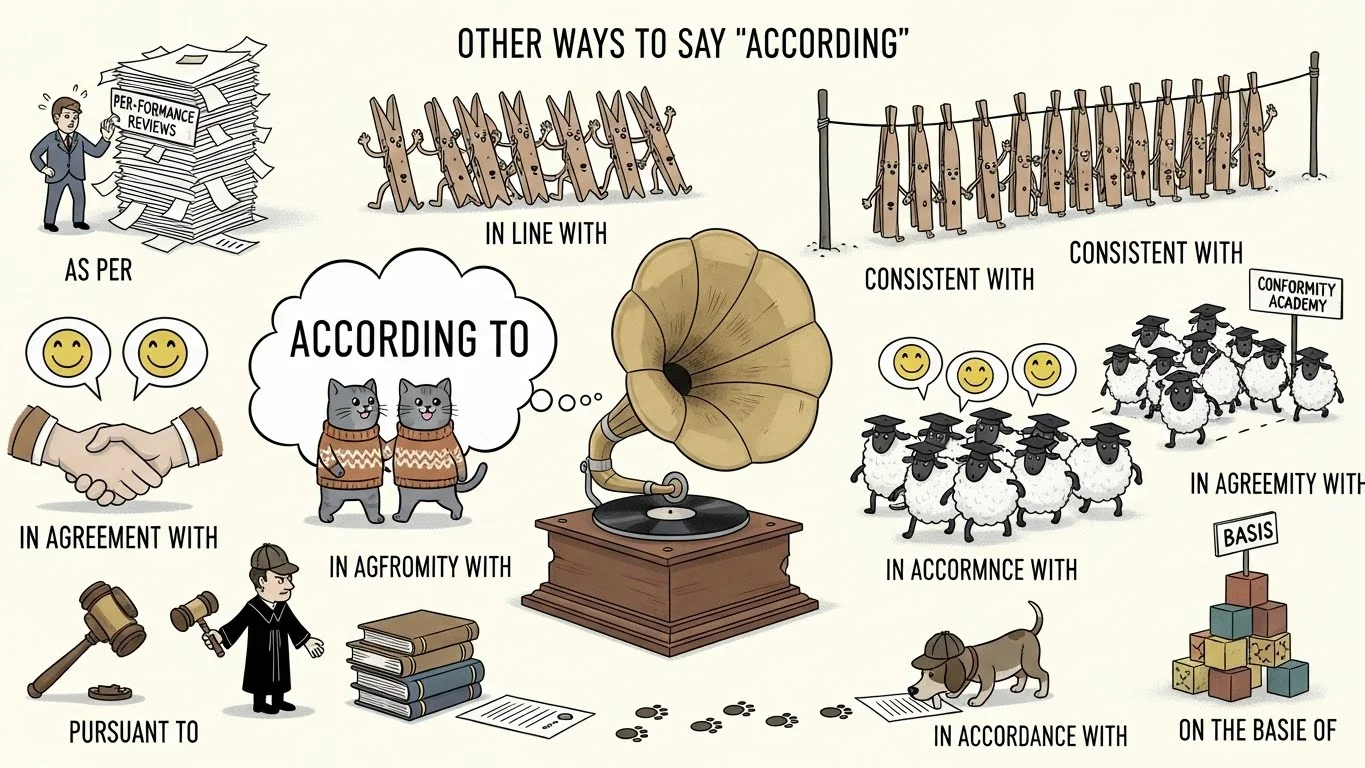
25 Other Ways To Say “According To”
👉 As stated by
👉 As reported by
👉 Based on
👉 As mentioned by
👉 As per
👉 In the words of
👉 As observed by
👉 In accordance with
👉 In line with
👉 As noted by
👉 In the opinion of
👉 Per
👉 As outlined by
👉 As detailed by
👉 As indicated by
👉 In the view of
👉 As explained by
👉 As highlighted by
👉 As recorded by
👉 As referenced by
👉 As documented by
👉 In keeping with
👉 In the estimation of
👉 In the judgment of
👉 In the findings of
As Stated By
Definition:
Directly cites the source’s words or statement.
Description:
Used in formal writing to indicate authority and clarity.
Examples:
• As stated by the researcher, the results were conclusive.
• As stated by the author, teamwork improves productivity.
As Reported By
Definition:
References information or news conveyed by a source.
Description:
Common in journalism, reports, and academic writing.
Examples:
• As reported by the study, pollution levels have decreased.
• As reported by the newspaper, the policy has been revised.
Based On
Definition:
Indicates reliance on data, information, or findings.
Description:
Simple, professional phrasing suitable for various contexts.
Examples:
• Based on the findings, further research is needed.
• Based on the survey, most participants prefer online learning.
As Mentioned By
Definition:
References a previously cited source or point.
Description:
Polite, professional phrasing for academic or corporate writing.
Examples:
• As mentioned by the author, regular exercise improves health.
• As mentioned by the speaker, collaboration is key to success.
As Per
Definition:
Formal, concise way to reference a source or guideline.
Description:
Widely used in professional, academic, and legal documents.
Examples:
• As per the report, revenues increased by 10%.
• As per company policy, employees must submit leave requests in advance.
In The Words Of
Definition:
Indicates a direct quote or phrasing from a source.
Description:
Formal and literary alternative for citing sources.
Examples:
• In the words of the author, “Consistency is the key to success.”
• In the words of the researcher, “The experiment yielded unexpected results.”
As Observed By
Definition:
Highlights observations made by a source.
Description:
Professional phrasing for scientific or research contexts.
Examples:
• As observed by the researcher, temperatures have risen over the years.
• As observed by the teacher, students benefited from interactive learning.
In Accordance With
Definition:
Aligns information with regulations, standards, or guidelines.
Description:
Formal phrasing suitable for professional and legal contexts.
Examples:
• In accordance with company policy, all reports must be submitted by Friday.
• In accordance with the study, results were analyzed statistically.
In Line With
Definition:
Indicates agreement or alignment with a source or principle.
Description:
Formal yet flexible phrasing for writing.
Examples:
• In line with the author’s findings, we adjusted our methodology.
• In line with the report, safety measures were implemented.
As Noted By
Definition:
Acknowledges an important point made by a source.
Description:
Professional alternative for “According to” in reports or essays.
Examples:
• As noted by the researcher, errors were minimal.
• As noted by the author, early intervention is crucial.
In The Opinion Of
Definition:
Refers to subjective statements or viewpoints of a source.
Description:
Useful when citing perspectives, critiques, or analyses.
Examples:
• In the opinion of the author, collaborative learning is effective.
• In the opinion of the expert, stricter regulations are needed.
Per
Definition:
Concise alternative for “According to.”
Description:
Widely used in professional, corporate, and academic contexts.
Examples:
• Per the guidelines, submissions are due by Monday.
• Per the report, market trends are improving.
As Outlined By
Definition:
Indicates information structured or explained by a source.
Description:
Formal phrasing for clarity and professionalism.
Examples:
• As outlined by the study, the steps are as follows.
• As outlined by the author, the theory has three components.
As Detailed By
Definition:
Refers to detailed explanation provided by a source.
Description:
Used in formal writing for accuracy and thoroughness.
Examples:
• As detailed by the report, the procedure was followed correctly.
• As detailed by the author, the results support the hypothesis.
As Indicated By
Definition:
Shows evidence or direction from a source.
Description:
Formal alternative suitable for professional or academic writing.
Examples:
• As indicated by the study, early intervention improves outcomes.
• As indicated by the data, trends are shifting positively.
In The View Of
Definition:
Refers to an author’s or expert’s perspective.
Description:
Professional phrasing suitable for analytical writing.
Examples:
• In the view of the researcher, collaboration enhances productivity.
• In the view of the author, policy reform is necessary.
As Explained By
Definition:
Cites clarification or explanation provided by a source.
Description:
Used in academic or professional writing for clarity.
Examples:
• As explained by the teacher, the formula must be applied carefully.
• As explained by the author, the steps follow logically.
As Highlighted By
Definition:
Draws attention to key points emphasized by a source.
Description:
Formal phrasing to stress important findings or arguments.
Examples:
• As highlighted by the study, early education is vital.
• As highlighted by the author, teamwork improves efficiency.
As Recorded By
Definition:
Refers to documented observations or information.
Description:
Formal and professional, suitable for reports or research.
Examples:
• As recorded by the committee, attendance has improved.
• As recorded by the historian, events occurred in 1910.
As Referenced By
Definition:
Cites sources used to support claims or statements.
Description:
Professional phrasing ideal for academic writing.
Examples:
• As referenced by the author, previous studies support this theory.
• As referenced by the report, data confirms the trend.
As Documented By
Definition:
Highlights information formally recorded by a source.
Description:
Professional, formal alternative for “According To.”
Examples:
• As documented by the report, the protocol was followed.
• As documented by the researcher, results were consistent.
In Keeping With
Definition:
Shows alignment with a principle, rule, or source.
Description:
Formal alternative suitable for professional or academic writing.
Examples:
• In keeping with the guidelines, we revised the process.
• In keeping with the study, we adjusted our methodology.
In The Estimation Of
Definition:
Refers to a source’s judgment or evaluation.
Description:
Formal phrasing for reports, research, or expert opinions.
Examples:
• In the estimation of the expert, success is likely.
• In the estimation of the author, further research is necessary.
In The Judgment Of
Definition:
Cites authoritative opinion or assessment.
Description:
Formal and professional, often used in reports or legal documents.
Examples:
• In the judgment of the committee, the proposal is acceptable.
• In the judgment of the researcher, the method is valid.
In The Findings Of
Definition:
Refers to conclusions or results presented in research.
Description:
Formal phrasing for academic, research, or scientific writing.
Examples:
• In the findings of the study, improvements were noted.
• In the findings of the report, the policy is effective.
Frequently Asked Questions
What does “According To” mean?
It is used to attribute information, ideas, or opinions to a source, author, or authority.
Is “According To” formal or informal?
It is formal and widely used in academic, professional, and research writing.
Can I use alternative phrases instead of repeating this?
Yes. Alternatives like “As noted by” or “In the opinion of” make your writing varied and engaging.
What is a professional alternative to “According To”?
“In accordance with,” “As outlined by,” or “As highlighted by” are formal alternatives.
What is a friendly or casual alternative?
“Based on” or “As mentioned by” works in semi-formal or neutral contexts.
Should I avoid repeating the same phrase multiple times?
Yes. Using varied alternatives improves readability, professionalism, and keeps your content engaging.