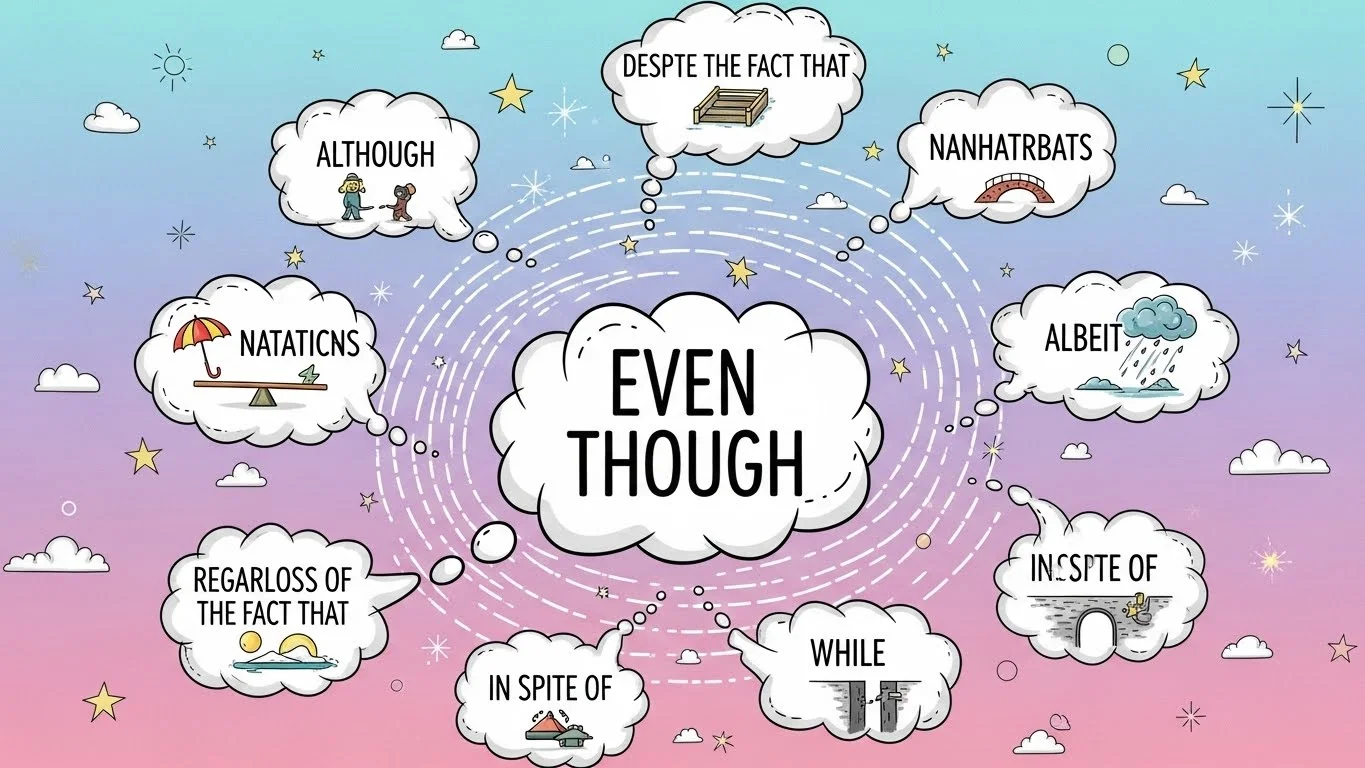
Even tough Finding the right words to express contrast in English can instantly upgrade your writing, whether you’re crafting essays, emails, stories, or professional content. While “even though” is a powerful phrase, relying on it too often can make your writing feel repetitive. That’s why exploring alternative phrases for ‘even though’ can improve clarity, variation, and emotional depth. These expressions help you show contrast, highlight unexpected results, and make your sentences more engaging.
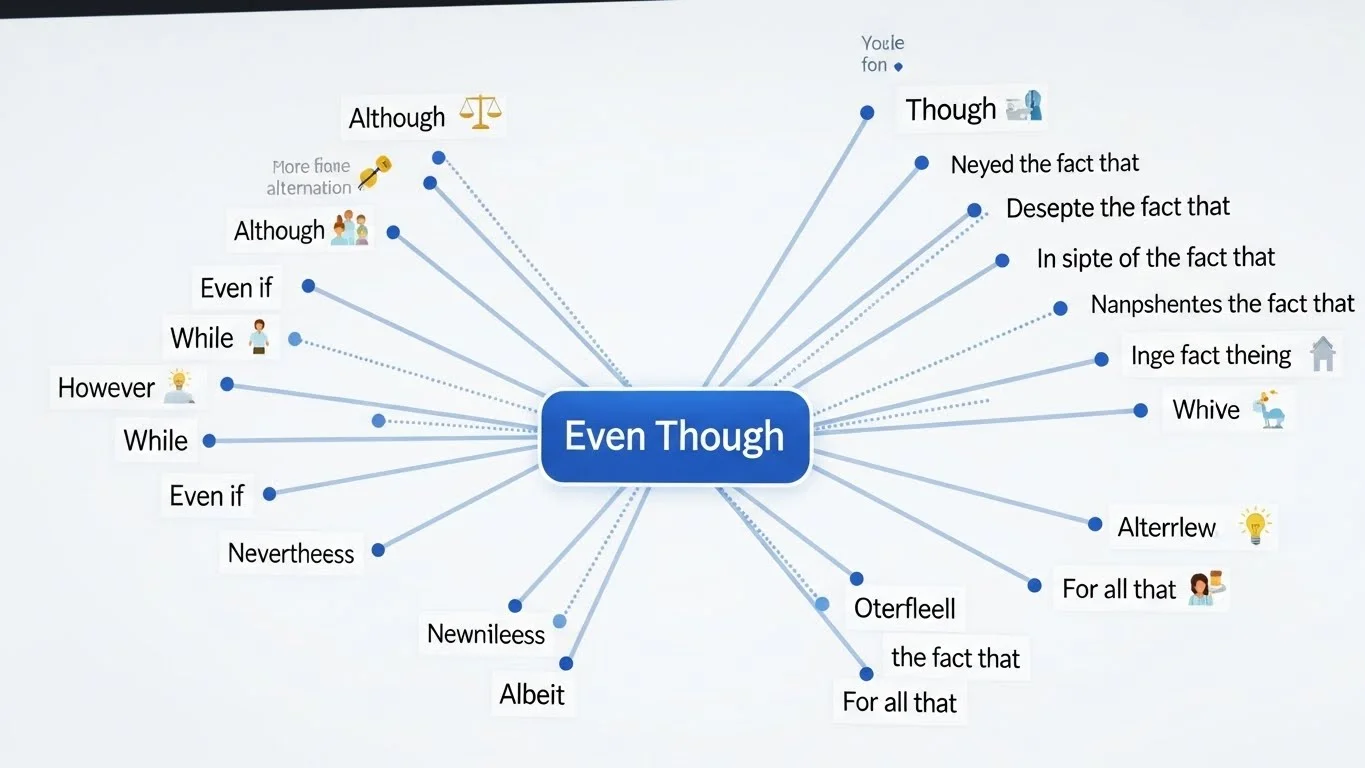
- 25 Other Ways To Say “Even Though”
- Although
- Though
- Despite the Fact That
- In Spite of the Fact That
- Whereas
- While
- Nevertheless
- Nonetheless
- Regardless of the Fact That
- Even If
- Albeit
- Yet
- However
- Still
- Despite
- In Spite Of
- Notwithstanding
- Be That As It May
- All the Same
- For All That
- Frequently Asked Questions
25 Other Ways To Say “Even Though”
👉 Although
👉 Though
👉 Despite the fact that
👉 In spite of the fact that
👉 Despite
👉 In spite of
👉 Whereas
👉 While
👉 Nevertheless
👉 Nonetheless
👉 However
👉 Yet
👉 Still
👉 Notwithstanding
👉 Regardless of the fact that
👉 Albeit
👉 Even if
👉 Much as
👉 When in fact
👉 For all that
👉 Admittedly
👉 Granted that
👉 Be that as it may
👉 Contrary to the fact that
👉 Irrespective of the fact that
Although
Definition: A conjunction used to introduce a contrast between two ideas.
Description: “Although” is one of the most common alternatives to “even though.” It is used in both formal and informal writing and creates a smooth transition between opposing thoughts.
Examples:
-
Although it was raining, we still went for a walk.
-
Although he was tired, he continued studying.
Though
Definition: A shorter and more casual version of “although.”
Description: Perfect for conversational English, it softens the contrast between ideas and flows naturally at the beginning or end of sentences.
Examples:
-
Though she was nervous, she delivered a great speech.
-
I liked the movie, though it was a bit long.
Despite the Fact That
Definition: A stronger phrase used to show a clear contradiction.
Description: Ideal for formal writing, this expression emphasizes how surprising or unexpected the result is.
Examples:
-
Despite the fact that he was sick, he went to work.
-
She smiled despite the fact that she was hurting.
In Spite of the Fact That
Definition: A formal phrase meaning the same as “despite the fact that.”
Description: Often used to highlight determination or unexpected outcomes in storytelling or academic writing.
Examples:
-
In spite of the fact that they warned him, he proceeded.
-
She succeeded in spite of the fact that many doubted her.
Whereas
Definition: A conjunction showing contrast between two clauses.
Description: Common in formal writing, comparisons, and debates. It highlights differences strongly.
Examples:
-
He loves traveling, whereas she prefers staying home.
-
Whereas most people rested, she kept working.
While
Definition: A conjunction showing contrast or simultaneous actions.
Description: “While” can compare two opposing ideas or show two actions happening at the same time.
Examples:
-
While I like coffee, he prefers tea.
-
She kept smiling while she was upset inside.
Nevertheless
Definition: An adverb meaning “in spite of that.”
Description: Adds a formal tone and emphasizes a surprising outcome.
Examples:
-
The task was tough; nevertheless, he finished it.
-
She was scared; nevertheless, she tried.
Nonetheless
Definition: Similar to “nevertheless,” used to introduce a contrasting idea.
Description: Ideal for essays and articles, giving writing a polished tone.
Examples:
-
It was risky; nonetheless, they agreed.
-
He had doubts; nonetheless, he joined.
Regardless of the Fact That
Definition: Used to show full disregard for obstacles or conditions.
Description: A formal phrase emphasizing determination or contrast.
Examples:
-
She went ahead regardless of the fact that no one supported her.
-
He applied, regardless of the fact that he lacked experience.
Even If
Definition: Shows a hypothetical contrast.
Description: Adds emotional depth, often used to show willingness or unconditional statements.
Examples:
-
I’ll support you even if no one else does.
-
He’ll come even if he’s busy.
Albeit
Definition: A formal conjunction meaning “although.”
Description: Used in academic or refined writing to show a mild contrast.
Examples:
-
It was a good plan, albeit risky.
-
She accepted the job, albeit reluctantly.
Yet
Definition: A conjunction meaning “but,” used to introduce contrast.
Description: Direct, simple, and works well in both speaking and writing.
Examples:
-
He is young, yet very wise.
-
It looked easy, yet it was challenging.
However
Definition: A transition word introducing a contrasting idea.
Description: Very common in essays and reports; adds professionalism and clarity.
Examples:
-
I wanted to go; however, I had work.
-
The weather was cold; however, we stayed outside.
Still
Definition: A word used to show something continues despite a condition.
Description: Adds emotional weight and makes contrast feel stronger.
Examples:
-
She was hurt; still, she forgave him.
-
He failed; still, he tried again.
Despite
Definition: A preposition showing contrast without using “that.”
Description: Short, elegant, and perfect for formal writing.
Examples:
-
Despite the rain, they played.
-
Despite his efforts, he lost.
In Spite Of
Definition: A prepositional phrase showing contrast.
Description: Common in everyday English, used to express unexpected results.
Examples:
-
In spite of his fear, he spoke.
-
In spite of the noise, she slept.
Notwithstanding
Definition: A formal way to say “despite.”
Description: Mostly seen in legal or academic texts but also works in formal writing.
Examples:
-
Notwithstanding the delay, the project continued.
-
Notwithstanding his apology, she stayed upset.
Be That As It May
Definition: A phrase meaning “even though that’s true.”
Description: Polite, formal, and often used to soften disagreement.
Examples:
-
Be that as it may, we must continue.
-
Be that as it may, her point still stands.
All the Same
Definition: Means “despite” or “nevertheless.”
Description: Great for casual and formal writing; adds emphasis.
Examples:
-
He was tired; all the same, he helped.
-
She disagreed; all the same, she supported him.
For All That
Definition: An old-fashioned phrase meaning “despite everything.”
Description: Adds a literary tone and highlights strong contrast.
Examples:
-
He was rude; for all that, she stayed calm.
-
For all that he tried, he couldn’t win.
Frequently Asked Questions
1. What can I use instead of “even though”?
You can use phrases like although, though, despite, whereas, nevertheless, and even.
2. Is “although” the same as “even though”?
Yes, both show contrast, but “even though” is slightly stronger.
3. Which alternative is most formal?
“Notwithstanding,” “albeit,” and “despite the fact that” are highly formal.
4. Can I use “but” instead of “even though”?
Sometimes yes, but “but” cannot replace “even though” in every sentence structure.
5. What is the simplest replacement?
“Though” is the easiest and most commonly used alternative.